
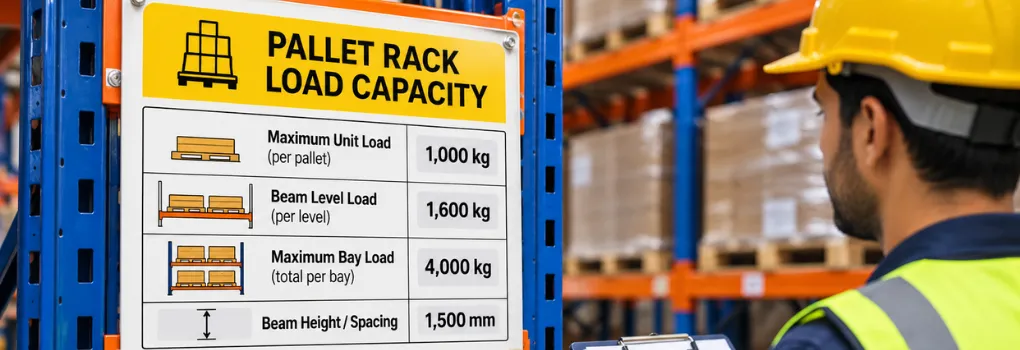
An empty spot in a pallet rack does not always mean it is safe to add another pallet. Before a forklift operator puts it there, someone needs to check how much weight that rack can hold.
That’s where load capacity signs for pallet racking come in. Often referred to as rack load notices, they indicate the approved limits for a given rack arrangement.
What Should You Look for on a Rack Load Notice?
First, check that the notice reflects the present rack layout, including the position of the beams. Depending on the system, it may list:
- Maximum unit load: Weight allowed per pallet loaded, including packaging and the pallet.
- Beam-level load: The combined weight allowed on one beam-supported level, for the specified load arrangement.
- Maximum bay load: The total permitted weight across the supported levels in that bay.
- Beam heights or spacing: The configuration on which the ratings are based.
Some notices use SWL (safe working load) and warn against unapproved changes. A sign from the next bay may not apply if the beam layout differs.
How Are Beam-Level and Bay Limits Different?
Say the sign allows 1,600 kg per beam level, but limits the whole bay to 4,000 kg. You have three levels. Loading each one to 1,600 kg brings the total to 4,800 kg. Each level meets its own limit, yet the bay is overloaded by 800 kg.
These numbers are examples, not AL Kheera Steel Works product ratings. You must stay within both limits. And when checking a unit load, include everything: if packed goods weigh 950 kg and the pallet adds 25 kg, the total is 975 kg.
Can Changing Beam Positions Affect Capacity?
Pallet racks are adjustable, but shifting a beam doesn’t mean the old rating still applies. Larger gaps between levels, a removed beam, or a replacement component can change how loads pass through the uprights.
Before making changes, ask the original supplier or a competent rack engineer to review the arrangement and update the load information if required. Our selective pallet racking guide explains how beams, uprights and safety locks work together.
What Should You Check Before Loading?
Before placing a pallet, check:
- Does the load notice match the rack as it stands today?
- Do you know the full weight of the loaded pallet, not just its contents?
- Will the additional pallet keep the beam level and bay within their limits?
- Are any uprights bent, beams damaged, or locking devices missing?
- Is the notice missing, unreadable, or out of date?
If so, don’t add more load to the affected bay until a competent person verifies the limits.
If an item puts most of its weight on a small area, ask whether the stated rating covers that loading pattern. A seemingly acceptable total weight doesn’t always make a load safe.
Unsure What Your Racks Can Carry?
If your racks have been altered, damaged, or installed without load information, get them assessed before loading. AL Kheera Steel Works offers warehouse rack inspection, repair, and modification services in the UAE. These services help a business find and fix problems in what they have installed.