
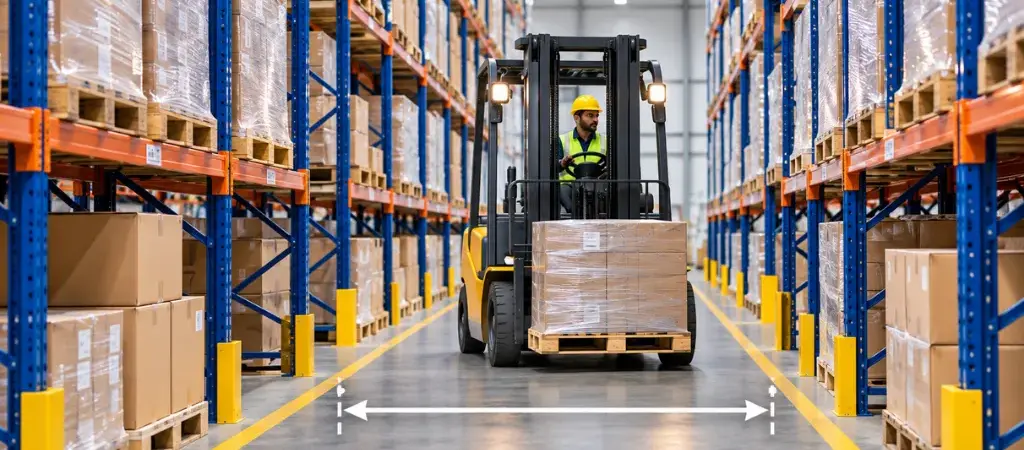
Adding another row of pallet racks might seem like an easy way to gain storage space. But those extra positions won’t help if your forklift cannot turn into the aisle with a loaded pallet. Forklift aisle width is something to work out before the racks are installed.
There is no single measurement for every warehouse. The right width depends on the truck, the pallets it carries, and how goods move through the building.
How Wide Does a Forklift Aisle Need to Be?
As a starting point, Toyota Material Handling provides these approximate ranges for common forklift types:
| FORKLIFT TYPE | TYPICAL AISLE WIDTH |
| Counterbalance forklift | 3.7–4.3 metres or more |
| Reach truck | 2.4–3.0 metres |
| Very narrow aisle (VNA) turret truck | 1.5–2.1 metres |
These are planning figures, not minimum widths that suit every forklift. Counterbalance trucks generally need more turning room than reach trucks. Even two counterbalance models may have different turning requirements, so a layout that works for your current forklift may not suit its replacement.
A VNA (Very Narrow Aisle) turret truck can operate in a tighter aisle, but it needs a layout designed for that equipment, often with a guidance system.
What Determines the Minimum Forklift Aisle Width?
Start with the manufacturer’s right-angle stacking aisle width, often listed as Ast. It describes the space needed to turn and position a specified load at 90 degrees.
Check what the figure includes. A basic right-angle stacking measurement may leave out the pallet length and operating clearance, so it cannot be used as the finished aisle width. For oversized loads, ask the equipment supplier to check the full manoeuvring path rather than relying on a catalogue figure.
Next, look beyond the truck’s specification sheet. Pallets may stick out beyond the rack beams. Column guards and rack protectors also take up room. Measure the narrowest clear space available when the racking is loaded, not just the distance between two empty rack frames.
What about Safety in a UAE Warehouse?
Forklifts are only part of the traffic picture. Workers need separate pedestrian routes, clearly marked crossing points, and safe access around loading areas.
Sharjah’s Safety in Warehousing guidance recommends vehicle routes wide enough for the largest vehicle using them, with pedestrians separated from moving equipment wherever practicable.
Check the turning space at aisle ends, blind corners and junctions too. An aisle can accommodate one truck and still cause problems where vehicles and people meet.
Keep routes clear of temporary stock as well; a pallet left near a corner can reduce both turning room and visibility.
Check the Layout Before Installing Racking
Before ordering new pallet racking systems, share your forklift model, pallet dimensions and floor plan with the supplier. Mark columns, doors and other fixed obstacles. If different forklift types use the same route, plan for the one needing the most room.
Our selective pallet racking guide explains other considerations when choosing a storage layout.
AL Kheera Steel Works supplies and installs warehouse storage systems across the UAE. Contact us and share your layout and handling requirements with our team so we can assist you in designing a racking arrangement that suits your daily operations.